Room 1008, Building 1, Cofco Yunjing, Martin Street, Heshui Kou Community, Guangming +86-13418798686 [email protected]
In the industrial application of high-performance materials, the resin itself is only half of the success equation. For B2B procurement officers and technical project leads in the furniture, flooring, and anti-corrosion sectors, the most catastrophic failure is not yellowing or bubbles—it is delamination. When a high-value epoxy coating or casting separates from its substrate, the resulting financial loss in materials, labor, and brand reputation can be immense.
At JHEPoxy, our R&D department views epoxy application not just as a "pouring" process, but as a complex exercise in Surface Engineering. This guide provides a deep technical dive into the molecular science of adhesion and the critical importance of substrate preparation.
1. The Molecular Logic of Adhesion: Chemical vs. Mechanical Bonding
To ensure a permanent bond that lasts for decades, we must understand how epoxy interacts with a surface at the microscopic level.
1.1 Mechanical Interlocking
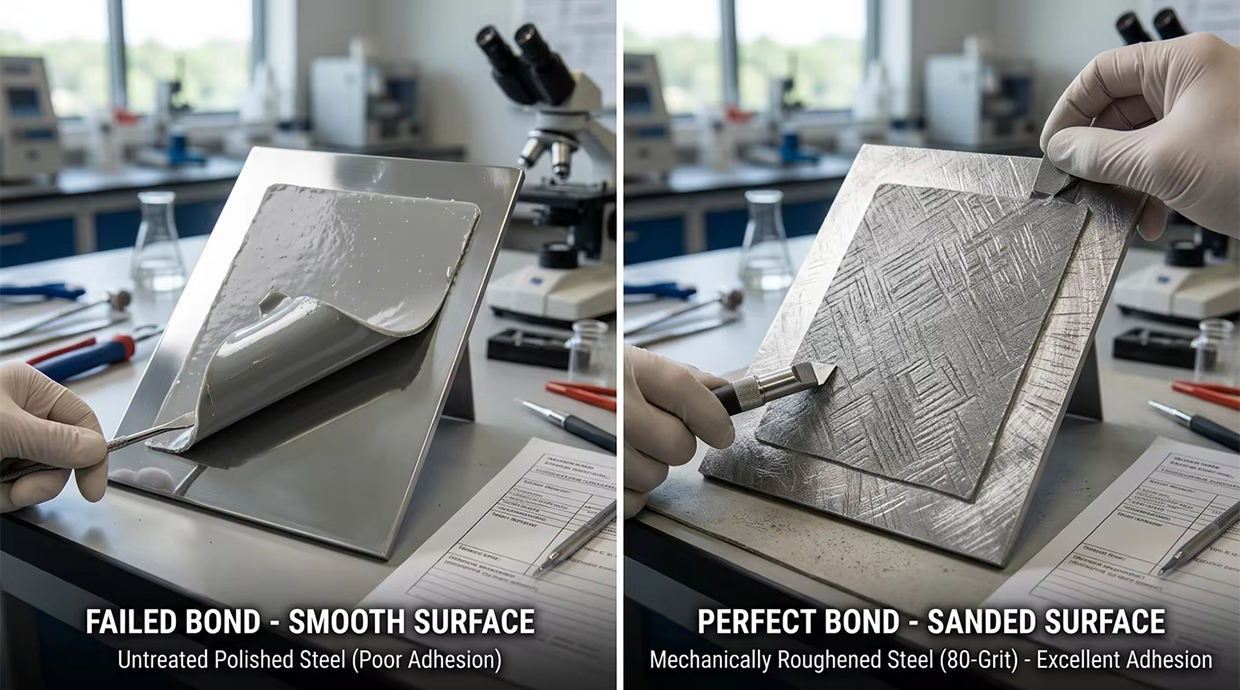
Mechanical bonding occurs when the liquid epoxy flows into the microscopic pores, crevices, and "valleys" of a roughened surface. Once cured, the resin becomes physically entangled with the substrate. This is why "sanding" is never optional. For substrates like high-density hardwoods or polished metals, achieving the correct Surface Profile is the first step in preventing delamination.
1.2 Chemical Covalent Bonding
Beyond mechanical locking, premium resins like ours are formulated to create chemical bonds with certain substrates. Our High-Performance Industrial Epoxy contains polar functional groups that are attracted to the hydroxyl groups found in wood cellulose and the oxide layers on metals. This "molecular bridge" creates a bond that is often stronger than the substrate itself.
2. Substrate-Specific Preparation: Wood, Metal, and Concrete
Different materials require vastly different preparation protocols. A "one-size-fits-all" approach is the leading cause of project failure in the B2B world.
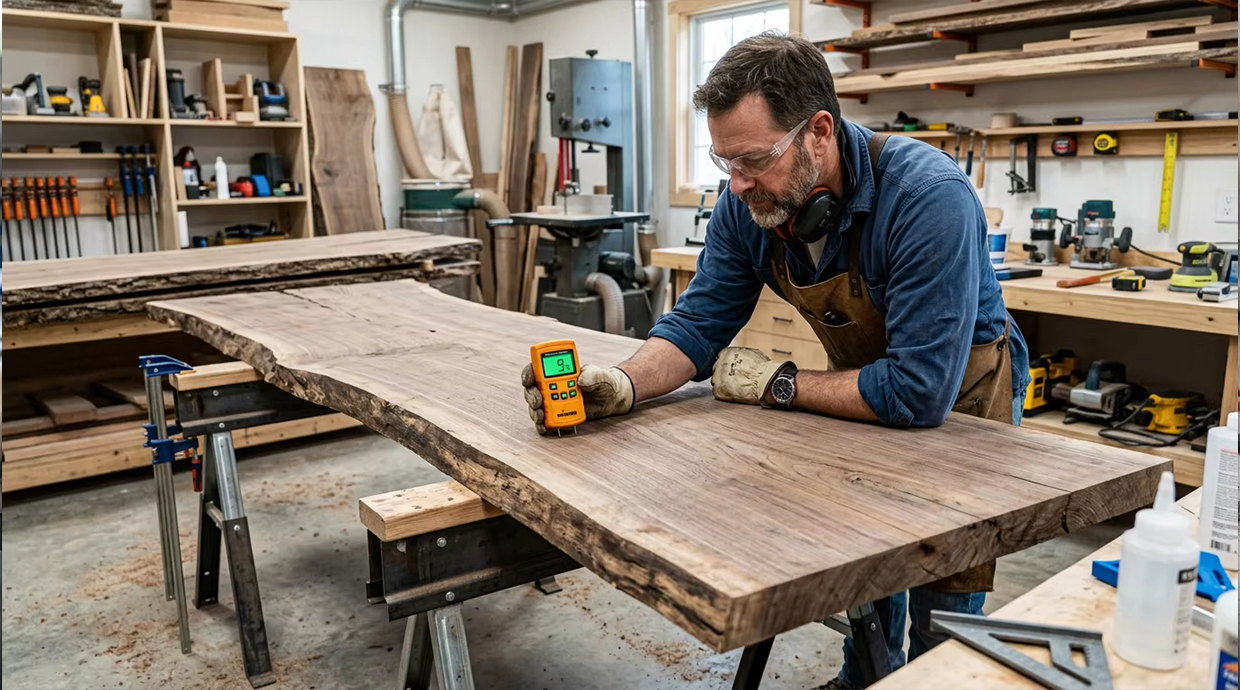
2.1 The Wood Challenge: Moisture and Resins
For furniture manufacturers creating River Tables, the primary enemy is Internal Moisture.
2.2 The Metal Challenge: Oxidation and Surface Energy
Metals like aluminum and stainless steel have high surface energy but are often covered in microscopic oils or oxidation layers.
3. Surface Energy and Wetting: Why Resin "Beads Up"
Have you ever seen epoxy pull away from an edge or form droplets like water on a waxed car? This is a failure of Wetting. If the Surface Energy of the substrate is lower than the Surface Tension of the liquid resin, the resin will not spread. JHEPoxy Solutions: Our formulas include advanced Wetting Agents that lower the surface tension of the resin, allowing it to "soak" into the substrate rather than sitting on top. This is critical for industrial coatings where a uniform, thin film is required over large areas.
4. ROI of Proper Preparation: Minimizing the "Failure Rate Cost"
In a B2B environment, the cost of the resin is negligible compared to the cost of a failed installation.
1.Scrap Reduction: Implementing a standardized sanding and cleaning protocol can reduce your factory’s scrap rate by up to 25%.
2.Warranty Claims: Professional engineering firms using our Knowledge Base have reported a 90% decrease in post-installation delamination claims.
5. The Standard Operating Procedure (SOP) for Maximum Adhesion
To achieve industrial-grade results, follow these five steps:
1.Cleanse: Use an industrial-grade de-greaser (Acetone or Denatured Alcohol).
2.Abrade: Sand with the appropriate grit (60-120 depending on substrate).
3.Vacuum & Tack: Remove all dust. A single layer of dust acts as a "release agent."
4.Prime/Seal: Apply a thin "Prime Coat" of resin to satisfy the substrate's porosity.
5.Main Pour: Cast the main layer while the Prime Coat is still "tacky" for a chemical cross-link.
6. Beyond the Guide: JHEPoxy Technical Support
We understand that every production environment is different. That is why JHEPoxy offers:
Conclusion
Adhesion is a science, not a gamble. At JHEPoxy, we don't just sell resin; we sell the engineering support to ensure that resin stays exactly where you put it.
Contact our technical team today for a customized Substrate Compatibility Report for your next large-scale project – or request a free dyne pen starter kit to begin auditing your own surface preparation process.
 Hot News
Factory-backed material solutions for manufacturers, brands and distributors worldwide. We specialize in liquid silicone rubber, epoxy resin, flooring materials and related products, providing reliable manufacturing, OEM customization and stable global supply.
Copyright © 2026 Shenzhen Jianghe New Materials Technology Co., Ltd.All rights reserved. Privacy Policy
 EN
EN