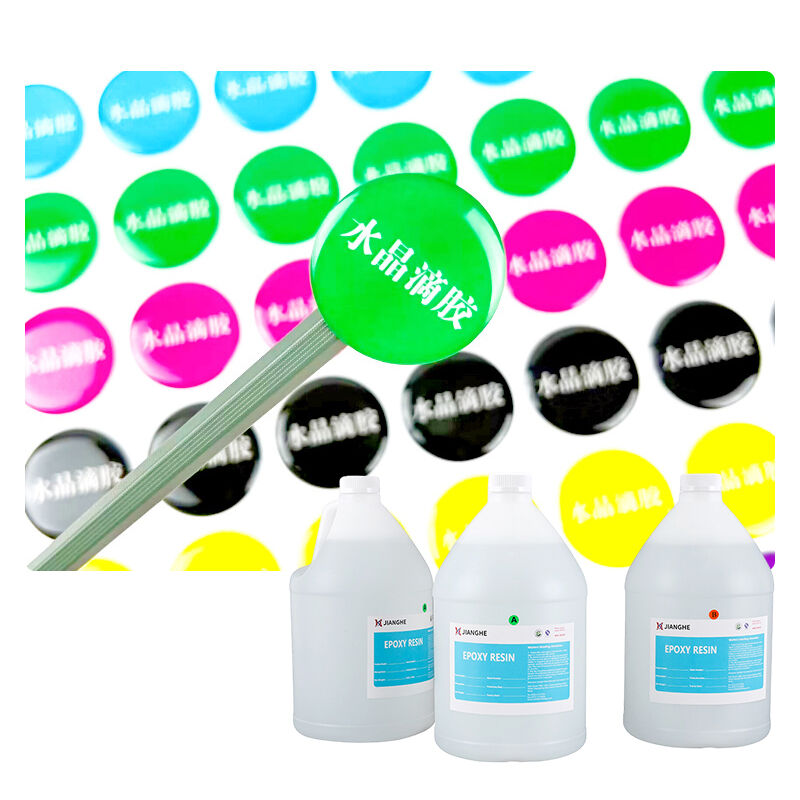
Fast Curing Resin Solutions - Ultra-Rapid Polymerization Technology for Industrial Applications

All Categories

Get a Tailored Solution

Provide your details below, and our material experts will contact you with a competitive quote and technical support within 24 hours.
Email
Name
Company Name
Message
0/1000

fast curing resin

Fast curing resin represents a revolutionary advancement in polymer technology, designed to significantly reduce processing time while maintaining exceptional performance characteristics. This specialized material combines rapid polymerization capabilities with outstanding mechanical properties, making it an ideal solution for time-sensitive manufacturing applications. Fast curing resin utilizes advanced chemical formulations that accelerate the cross-linking process, enabling complete solidification within minutes rather than hours. The main functions of fast curing resin include providing strong adhesive bonding, creating durable protective coatings, and forming rigid structural components across various industries. Technological features encompass low-temperature curing capabilities, minimal shrinkage during polymerization, excellent chemical resistance, and superior adhesion to multiple substrate materials. The resin's unique molecular structure allows for rapid chain formation while preserving dimensional stability and mechanical integrity. Applications span automotive manufacturing, electronics assembly, aerospace components, marine construction, and rapid prototyping processes. In automotive sectors, fast curing resin enables efficient production line operations by reducing cycle times for component bonding and coating applications. Electronics industries benefit from quick assembly processes where delicate components require immediate protection without extended curing periods. Aerospace applications leverage the material's ability to create lightweight yet strong composite structures within compressed manufacturing schedules. Marine environments utilize fast curing resin for hull repairs and protective coatings that must cure quickly despite challenging weather conditions. The rapid prototyping industry relies heavily on this technology to produce functional parts with minimal waiting time between design iterations. Advanced formulations incorporate nano-additives that enhance thermal conductivity and improve heat dissipation during the curing process, preventing excessive temperature buildup that could compromise material properties.

New Product Releases

Fast curing resin delivers substantial practical benefits that directly impact productivity and operational efficiency across manufacturing environments. Time savings represent the most significant advantage, with typical curing cycles reduced from several hours to just 15-30 minutes, allowing manufacturers to increase throughput dramatically and meet tight production deadlines. This acceleration translates into immediate cost reductions through improved equipment utilization and reduced labor costs associated with extended processing times. Energy consumption decreases substantially because fast curing resin requires less heating time and lower temperature settings compared to conventional alternatives, resulting in reduced utility bills and improved environmental sustainability. The material's consistent performance eliminates common issues like incomplete curing or temperature-related defects that plague traditional resins, reducing waste and rework expenses significantly. Inventory management becomes more efficient as faster turnaround times reduce work-in-progress accumulation and allow for more responsive production scheduling. Quality control improves because the shorter curing window provides better process control and more predictable outcomes, leading to higher first-pass yield rates and customer satisfaction. Workplace safety benefits emerge from reduced exposure to volatile compounds during shorter processing cycles, creating healthier working conditions for employees. Equipment versatility increases as the same machinery can handle multiple product lines with rapid changeovers, maximizing capital investment returns. Storage requirements diminish because components spend less time in curing fixtures, freeing up valuable floor space for other operations. Temperature tolerance allows processing in ambient conditions without specialized heating equipment, reducing infrastructure costs and complexity. Maintenance schedules become more flexible as equipment operates more efficiently with shorter duty cycles, extending machinery lifespan and reducing downtime. Supply chain responsiveness improves as manufacturers can quickly adapt to changing customer demands without long lead times associated with extended curing processes. Market competitiveness strengthens through faster delivery times and the ability to handle rush orders effectively, opening new business opportunities and strengthening customer relationships.

Tips And Tricks

How Does Anti-Yellowing Resin Maintain Long-Term Visual Clarity?

17

Dec

How Does Anti-Yellowing Resin Maintain Long-Term Visual Clarity?

The Importance of Visual Stability in Modern Epoxy Applications Anti-Yellowing Resin has become a critical material choice in epoxy systems where long-term appearance, transparency, and color consistency are as important as mechanical performance. In...
View More
Why Do Mold Makers Choose Liquid Silicone for Complex Mold Projects?

04

Jan

Why Do Mold Makers Choose Liquid Silicone for Complex Mold Projects?

Liquid Silicone in Modern Mold Making Liquid silicone has become the material of choice for mold makers seeking precision, flexibility, and durability in their projects. Its unique properties allow manufacturers to produce complex molds that traditio...
View More
Why Is Clear Epoxy Resin More Prone to Yellowing?

10

Jan

Why Is Clear Epoxy Resin More Prone to Yellowing?

Understanding the Yellowing of Clear Epoxy Resin Clear epoxy resin is widely used in flooring, furniture, art, and industrial applications due to its transparency, durability, and glossy finish. However, one common challenge faced by manufacturers, a...
View More
What Factors Limit the Service Life of Mold Making Silicone?

16

Jan

What Factors Limit the Service Life of Mold Making Silicone?

Understanding the Service Life of Mold Making Silicone Mold making silicone is widely used by manufacturers, artisans, and industrial professionals for its flexibility, durability, and precision. Despite its many advantages, the service life of mold ...
View More

Get a Free Quote

Our representative will contact you soon.
Email
Name
Company Name
Message
0/1000

fast curing resin

Ultra-Rapid Polymerization Technology

Ultra-Rapid Polymerization Technology

The ultra-rapid polymerization technology integrated into fast curing resin represents a breakthrough in chemical engineering that fundamentally transforms manufacturing timelines. This sophisticated system employs carefully balanced catalyst networks that trigger immediate molecular cross-linking upon activation, creating a cascade reaction that propagates throughout the material within seconds. The technology utilizes proprietary accelerator compounds that remain stable during storage but activate instantaneously when exposed to specific environmental conditions such as ambient temperature or UV light exposure. This controlled activation mechanism ensures consistent curing performance while preventing premature hardening during handling and application processes. The polymerization process generates minimal heat buildup, preventing thermal stress that could compromise material integrity or cause dimensional distortion in sensitive applications. Advanced molecular design incorporates flexible polymer chains that maintain elasticity even after rapid curing, providing excellent impact resistance and durability under dynamic loading conditions. The technology's versatility allows formulation adjustments to optimize curing speed for specific applications, ranging from ultra-fast 5-minute cycles for emergency repairs to moderate 20-minute cycles for precision assembly work. Quality control benefits significantly from this predictable curing behavior, as manufacturers can establish precise timing protocols that ensure complete polymerization without overcuring that could lead to brittleness or reduced performance. The rapid polymerization also creates superior interfacial bonding with substrate materials because the quick setting action minimizes contamination opportunities and locks in optimal surface contact conditions. This technology enables manufacturing processes that were previously impossible with conventional materials, opening new possibilities for innovative product designs and production methodologies. Environmental benefits include reduced energy consumption and lower emissions from shortened processing cycles, supporting sustainability initiatives while maintaining high-performance standards.
Superior Mechanical Performance Under Accelerated Curing

Superior Mechanical Performance Under Accelerated Curing

Fast curing resin maintains exceptional mechanical properties despite its accelerated polymerization timeline, challenging the traditional assumption that rapid curing compromises material strength and durability. Advanced polymer science techniques ensure that the quick cross-linking process creates optimal molecular network structures that equal or exceed the performance of slower-curing alternatives. Tensile strength measurements consistently demonstrate values comparable to aerospace-grade materials, with typical ratings exceeding 8,000 psi in standard test conditions. Flexural modulus properties remain stable across varying curing speeds, providing engineers with reliable design parameters regardless of production timeline constraints. Impact resistance testing reveals superior energy absorption capabilities, making fast curing resin suitable for demanding applications where shock loading occurs regularly. The material's compressive strength characteristics support heavy structural loads without deformation, enabling use in load-bearing applications where safety factors are critical. Fatigue resistance testing under cyclic loading conditions shows minimal degradation over millions of stress cycles, confirming long-term reliability in dynamic service environments. Chemical resistance properties maintain their effectiveness throughout the rapid curing process, providing excellent protection against solvents, acids, bases, and environmental contaminants. Thermal stability extends across wide temperature ranges, with glass transition temperatures remaining consistent regardless of curing speed variations. Adhesion strength to various substrates actually improves with fast curing formulations because the rapid setting action creates intimate molecular contact before contamination can occur. Dimensional stability during curing shows minimal shrinkage percentages, typically less than 2 percent linear change, which is crucial for precision manufacturing applications. Creep resistance under sustained loading conditions demonstrates excellent long-term performance, making the material suitable for permanent installations where dimensional changes could cause system failures. These superior mechanical characteristics enable engineers to specify fast curing resin in critical applications without performance compromises, effectively eliminating the traditional trade-off between processing speed and material quality.
Versatile Application Compatibility Across Industries

Versatile Application Compatibility Across Industries

The remarkable versatility of fast curing resin enables seamless integration across diverse industrial applications, providing manufacturers with a single material solution that addresses multiple production challenges simultaneously. Automotive manufacturing benefits from this adaptability through applications ranging from structural bonding of composite body panels to rapid repair of production line equipment, with the material's quick-setting properties supporting just-in-time manufacturing philosophies. Electronics industries leverage the resin's excellent dielectric properties and rapid curing characteristics for potting sensitive components, creating protective barriers against moisture and vibration while maintaining manufacturing throughput. Aerospace applications utilize the material's lightweight properties and chemical resistance for both structural repairs and component manufacturing, where certification requirements demand consistent performance across varying environmental conditions. Marine industries benefit from the resin's saltwater resistance and ability to cure in humid conditions, enabling hull repairs and deck coating applications that would be impossible with moisture-sensitive alternatives. Construction applications take advantage of the material's structural strength and weather resistance for both emergency repairs and planned installations, with rapid curing enabling project completion within tight scheduling constraints. Medical device manufacturing utilizes biocompatible formulations that meet FDA requirements while providing the quick turnaround times essential for responsive healthcare equipment production. Sporting goods manufacturing leverages the material's impact resistance and lightweight characteristics for equipment that demands both performance and durability under extreme usage conditions. Art and restoration applications benefit from the controllable working time and excellent color stability that preserves aesthetic qualities while providing structural integrity. Industrial maintenance operations rely on the material's ability to cure quickly in challenging environments, minimizing equipment downtime and production interruptions. The formulation flexibility allows customization for specific industry requirements, including flame retardant versions for electrical applications, food-grade formulations for packaging industries, and high-temperature variants for automotive exhaust systems. This broad compatibility eliminates the need for multiple specialized materials, simplifying procurement processes and reducing inventory complexity while maintaining optimal performance standards across all applications.

Get Samples & Support

Email
Name
Company Name
Country/Region
What Are You Making
Single Choice
Estimated Monthly Usage
Single Choice
Message
0/1000